
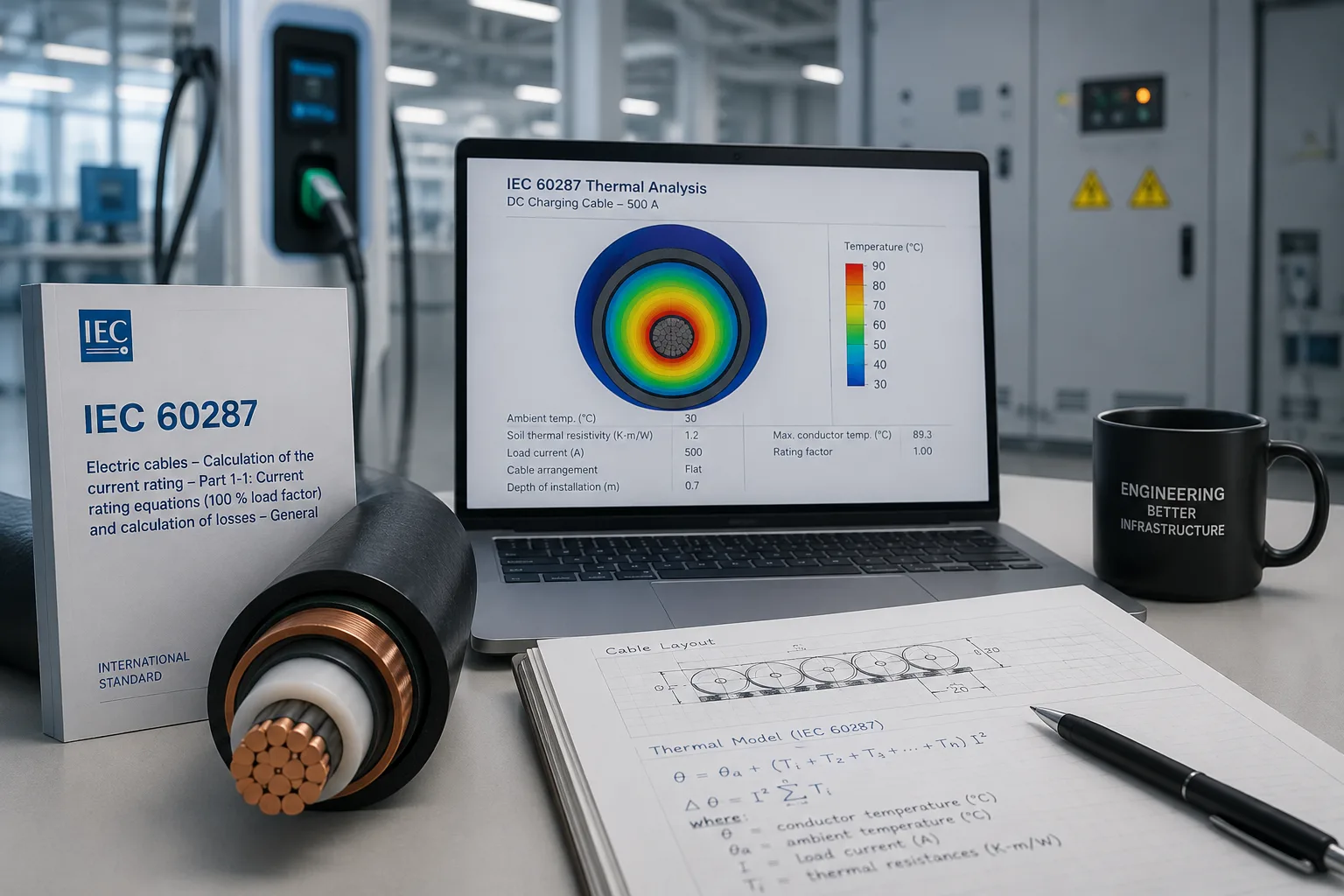
IEC 60287 is a recognised, steady-state method for cable thermal analysis. Rather than relying only on a generic current-carrying capacity, it determines the expected conductor temperature at the relevant parts of an installation, assessed against the cable construction, circuit loading, duct geometry and ground conditions. On EV charging schemes it is applied where multiple heavily loaded AC and DC circuits share trenches, stacked duct banks or common ducts — so that each cable is affected not only by its own losses, but by heat transferred from neighbouring circuits.
High-power EV charging installations often involve underground cable arrangements that are more complex than the standard configurations represented by conventional cable-sizing tables.
When are BS 7671 cable-sizing tables not sufficient?
BS 7671 provides a robust method for cable selection, including correction factors for ground temperature, burial depth, soil thermal resistivity and grouping. Where the installation aligns with the tabulated arrangements, this is generally sufficient. The limitation arises where multiple heavily loaded AC and DC circuits share trenches, stacked duct banks or common ducts. Each cable is then affected not only by its own losses, but by heat transferred from neighbouring circuits.
IEC 60287 provides a recognised method for assessing those thermal interactions against the cable construction, circuit loading, duct geometry and ground conditions. Soil thermal resistivity is a key input: on larger schemes, a measured value, or a stated conservative assumption, is often the difference between a defensible calculation and a contested one.
Cable temperature limits versus equipment terminal ratings (BS 7671 Regulation 512.1.5)
The key benefit of IEC 60287 is that it determines the expected conductor temperature at the relevant parts of the installation, rather than relying only on a generic current-carrying capacity. This matters because the maximum permitted cable temperature and the maximum equipment terminal temperature may differ. Under BS 7671 Regulation 512.1.5, equipment is assumed suitable for conductors at 70°C unless the manufacturer confirms a higher rating; some provide evidence that their terminals are suitable for 80°C or 90°C operation.
A 90°C-rated cable may therefore operate safely within its construction limit while still exceeding the allowable temperature at the charger or switchgear terminal. Both limits must be considered.
Why the most onerous point may be a grouped duct bank, not the termination
The most onerous point of a cable route may lie within a heavily grouped underground section rather than at the equipment termination. A cable may exceed 70°C within a short grouped duct bank while remaining below its 90°C insulation limit. Once it leaves that section for a less onerous arrangement, its temperature reduces, and where sufficient distance is available before the equipment, the conductor may cool to within the terminal limit.
The design should therefore demonstrate:
- that the cable remains within its permitted operating temperature throughout the route; and
- that the conductor temperature at the point of termination remains within the equipment manufacturer's limit.
Treating the whole route as though it must remain below 70°C may lead to unnecessary oversizing. Equally, relying only on the cable's insulation rating may expose equipment terminals to excessive temperatures.
Why standard grouping factors cannot represent every duct arrangement
Standard grouping factors are based on defined arrangements and cannot represent every installation geometry. IEC 60287 is particularly valuable where ducts are vertically stacked or irregularly arranged, several high-load circuits share one trench, AC and DC systems are installed together, or adjacent circuits operate at different loads.
A cable near the centre of a duct bank experiences more mutual heating than one at the outer edge. A geometric assessment allows each circuit to be considered in its actual position. IEC 60287 is a steady-state method, which is appropriately conservative for charging hubs operating at sustained high utilisation.
How the analysis changes cable sizing decisions
The analysis helps determine whether the correct response is to increase the cable size, increase duct spacing, redistribute or separate heavily loaded circuits, provide a longer ungrouped section before termination, or obtain confirmation of a higher terminal rating from the manufacturer.
Its purpose is not simply to produce an alternative current rating. It is to determine the expected operating temperature of the cables at the critical sections of the route. For complex EV charging infrastructure, this provides a more accurate and defensible basis for cable sizing while properly coordinating cable construction limits with charger and switchgear terminal ratings.