
Electrical Design & Calculations
The technical engineering behind safe, compliant and buildable electrical installations. From BS 7671 electrical design and IEC 60287 cable thermal analysis to protection studies, earthing design, fault-level calculations and construction-ready documentation, EV Design provides specialist electrical engineering for commercial, industrial and EV charging infrastructure projects.
Specialist Electrical Calculations Beyond Standard Design
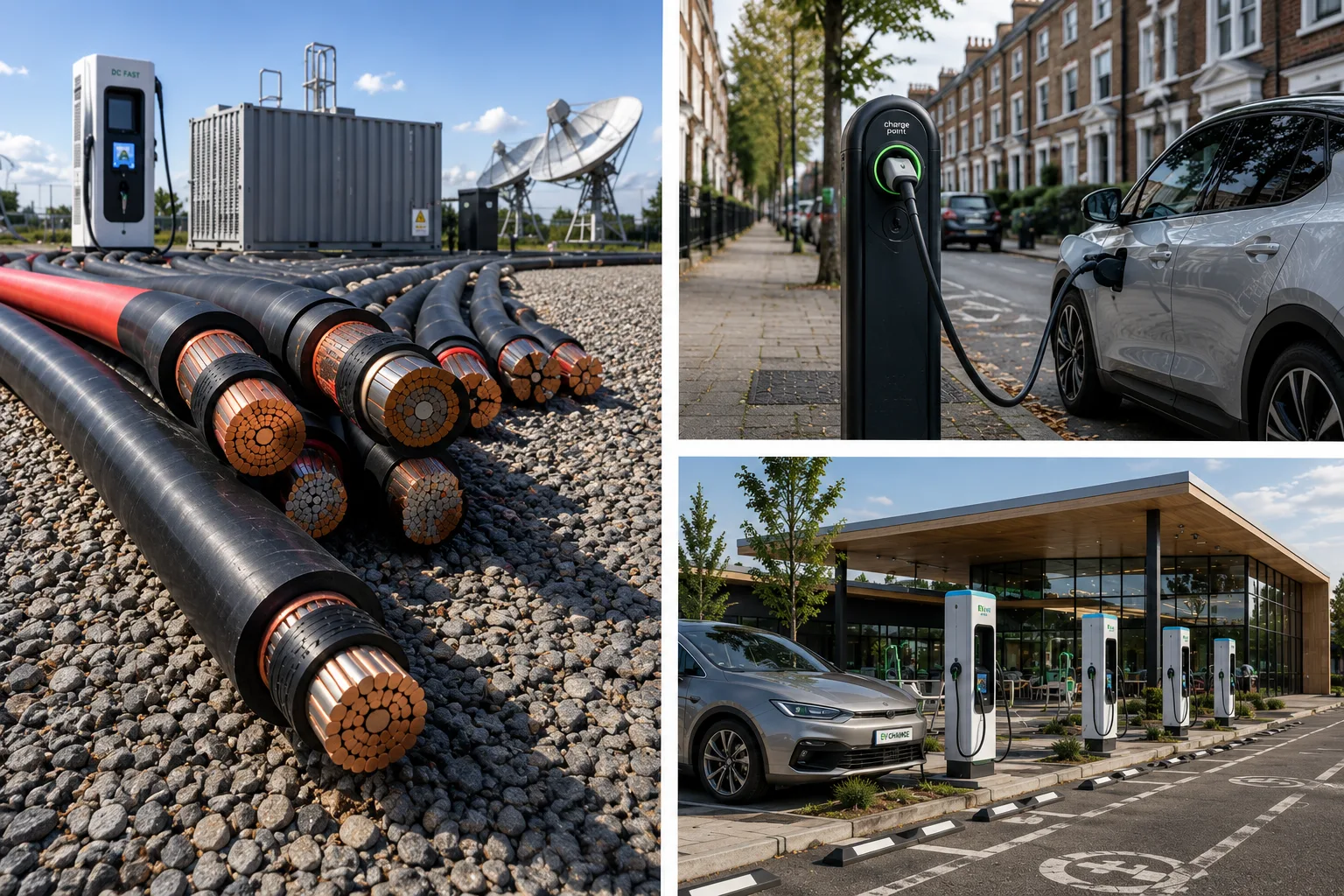
High-power electrical infrastructure often requires engineering beyond standard cable sizing and generic design assumptions. EV Design undertakes specialist electrical calculations to develop safe, compliant and buildable installations for complex electrical infrastructure projects.
Our capabilities include BS 7671 electrical design, IEC 60287 cable thermal analysis, protection and fault level studies, RCD selection and DC blinding assessments, earthing design, voltage drop calculations, AC and DC cabling design, duct route coordination, and the production of construction-ready electrical tender documentation.
These engineering assessments are particularly important for EV charging, eHGV and Megawatt Charging System (MCS) infrastructure, where continuous loading, grouped cable installations, buried duct networks, site constraints and future expansion requirements can significantly influence the final design.
Designed around real installation conditions
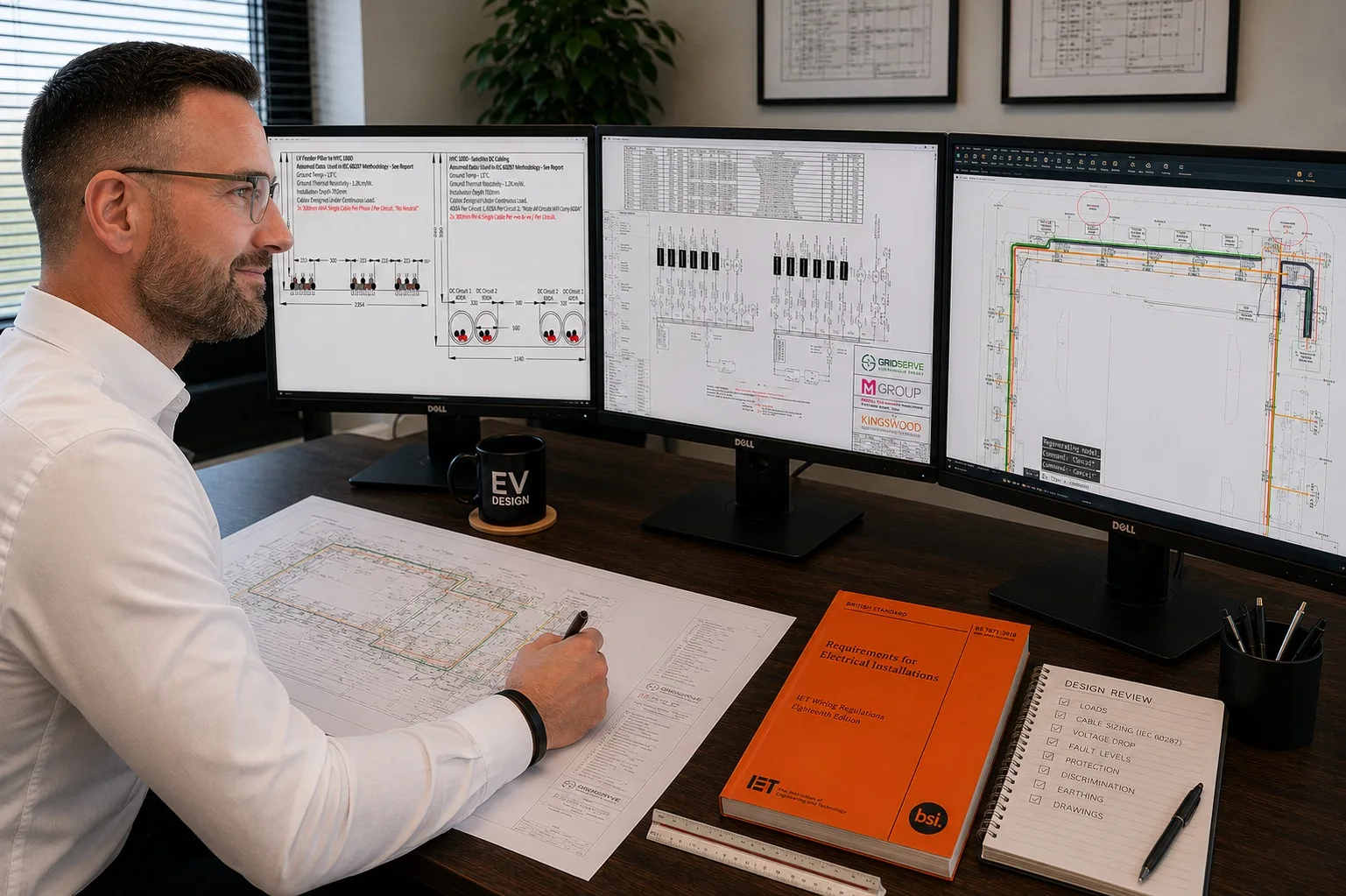
For high-power EV infrastructure, cable performance is often governed by how the cables are installed, grouped and routed, not the cable size alone.
EV Design assesses duct arrangements, cable grouping, spacing, burial depth, operating temperature limits and termination constraints to determine whether the proposed cable system is suitable for continuous high-load operation. The calculation method behind that assessment is set out in our technical article on IEC 60287 cable thermal analysis.
IEC 60287
IEC 60287 cable thermal analysis for high-power infrastructure
Standard BS 7671 current-carrying capacity tables are based on defined installation methods and reference conditions. High-power EV charging infrastructure often involves grouped cable systems, buried duct networks and sustained high-load operation that require engineering beyond standard tabulated cable ratings.
First-principles thermal modelling
Current-carrying capacity is assessed using the proposed installation conditions, including burial depth, cable grouping, duct arrangements and operating temperature limits.
Applied to high-power cable systems
Used where standard tabulated ratings do not provide sufficient engineering confidence for the proposed installation.
Designed for long-term performance
Appropriate cable sizing helps maintain conductor temperatures within design limits, supporting reliable operation throughout the life of the installation.
Terminal temperature assessment
Where required, cable performance is considered alongside equipment terminal temperature limitations to develop a complete engineering solution.
Complete Electrical Design Capabilities
Every electrical engineering discipline required to deliver an EV charging project from feasibility through to construction-ready documentation, produced to a standard suitable for DNOs, contractors, clients and principal designers.
IEC 60287 Cable Thermal Analysis
First-principles cable thermal modelling in accordance with IEC 60287, determining conductor current-carrying capacity under the proposed installation conditions. Used to optimise cable sizing for high-power AC and DC infrastructure where standard BS 7671 tabulated cable ratings are no longer sufficient.
Electrical Load & Capacity Assessments
Assessment of existing electrical capacity, maximum demand, diversity and future load requirements to determine available network capacity, identify reinforcement requirements and support DNO and iDNO connection applications.
Cable Sizing & Routing Design
Design of AC and DC cable systems, including conductor sizing, voltage drop, short-circuit withstand, installation methods and practical routing. Where practicable, AD8-rated cable systems are specified for ducted installations to provide enhanced resilience against water ingress and long-term environmental performance.
Ducting & Cable Route Coordination
Design and coordination of underground duct networks, draw pits, cable routes and containment systems, including duct selection in accordance with BS 7671 Regulation 522.8.10. Where unarmoured buried cables are installed, ducting is specified to provide suitable mechanical protection, including 750 N compression resistance, in accordance with the latest requirements of BS 7671.
Earthing, Bonding & Protective Measure Design
Design of TN-S, TN-C-S and TT earthing systems, including earth electrode design, bonding arrangements, O-PEN protective measures, touch voltage considerations and compliance with BS 7671 and the IET Code of Practice for Electric Vehicle Charging Equipment Installation.
Simultaneous Contact & Electrical Safety Assessments
Engineering assessment of simultaneous contact risks, touch voltages, transferred potentials and earthing interactions associated with EV charging infrastructure, ensuring safe and compliant electrical installations in accordance with BS 7671 and relevant industry guidance.
Protection, Fault-Level & Discrimination Studies
Calculation of prospective fault current, protective device selection and discrimination studies to ensure faults are safely cleared, protective devices are correctly coordinated and security of supply is maintained throughout the electrical installation.
RCD Selection & DC Blinding Assessment
Engineering assessment of residual current protection for EV charging infrastructure, considering fault protection, additional protection where required, smooth DC residual currents and the potential for DC blinding. Protective measures are selected to ensure compliance with BS 7671, the IET Code of Practice for Electric Vehicle Charging Equipment Installation and charging equipment manufacturer requirements.
Equipment Compound & Feeder Pillar Layouts
Design and coordination of electrical equipment compounds, feeder pillars, switchgear, metering arrangements and cable entry layouts, ensuring suitable access, clearances, maintainability and allowance for future expansion.
Associated Site Lighting Design
Design of external lighting associated with EV charging infrastructure, including charger compounds, parking areas, access routes and operational zones, coordinated with the wider electrical distribution and site layout.
Tender Drawings, Specifications & Schedules
Preparation of construction-ready electrical drawings, single-line diagrams, layout drawings, cable schedules, equipment schedules, technical specifications and supporting documentation suitable for tender and construction.
Construction Stage Technical Support
Technical support throughout construction, including contractor queries, drawing reviews, technical submissions, site inspections, design revisions, commissioning support and engineering assistance through to project completion.
Ready to start your EV charging project?
Talk to us about feasibility, electrical design and technical support for your EV charging project, UK wide.
What an EV charging consultant does