
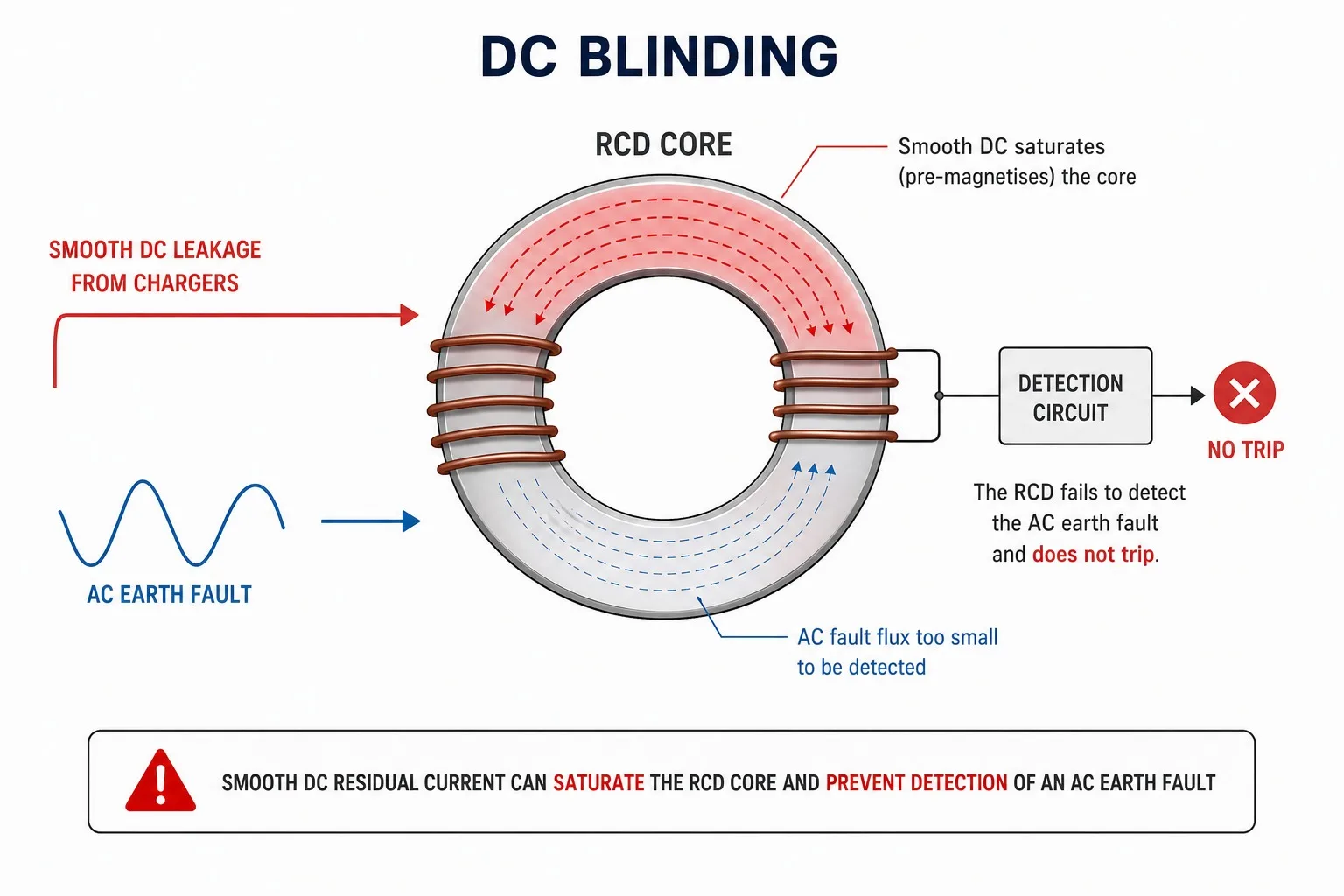
DC blinding is the loss of residual-current detection that occurs when smooth direct current saturates the magnetic core of an RCD's sensing transformer — leaving an AC earth fault unable to produce sufficient change in flux for the device to operate. It is the reason RCD selection for DC charging installations cannot be based on device type alone.
DC fast-charging equipment can introduce smooth direct current (DC) residual current into the upstream electrical installation. On a TT system, a Residual Current Device (RCD) is commonly used for fault protection because the earth-fault current may be insufficient to operate the circuit's overcurrent protective device within the required disconnection time. Reliable RCD operation is therefore fundamental to achieving Automatic Disconnection of Supply (ADS).
What is DC blinding, and why is 6 mA the Type A limit?
The key question is: can an upstream Type A device still detect an AC earth fault while smooth DC leakage from the chargers is present? Type A RCDs are designed to detect sinusoidal AC and pulsating DC residual currents. They are only assured to operate correctly with smooth DC residual current up to 6 mA.
Beyond this level, smooth DC can pre-magnetise and saturate the magnetic core of the RCD's sensing transformer. With the core held in saturation, an AC earth fault no longer produces sufficient change in flux for the device to detect it, and the RCD may fail to operate. This effect is commonly known as DC blinding.
Why the incoming device is the most exposed in the protection hierarchy
A large DC charging installation may include residual-current protection within the charger, protection on each outgoing charger feeder and incoming protection at the feeder pillar or switchboard. Each device protects a different part of the installation: the charger protection deals with faults within the charging equipment, the outgoing device protects the feeder cable, and the incoming device protects the distribution equipment and supports ADS across the TT system.
Critically, smooth DC leakage is cumulative. The incoming device sees the sum of the leakage from every downstream charger, making it the most exposed device in the hierarchy. These devices must therefore be considered as one coordinated protection system.
Does BS 7671 Section 722 allow a Type A RCD upstream of a Type B?
Where DC fault current may be present, BS 7671 Section 722 requires protection by a Type B RCD to BS EN 62423, or equivalent measures such as residual direct current detecting devices (RDC-DD) to BS IEC 62955. Consistent with this, a Type A RCD should not generally be installed upstream of a Type B device, because the Type A device could be blinded.
A Type A device may, however, be used upstream where the manufacturer has carried out independent testing demonstrating that the specific device will continue to detect AC leakage in the presence of the expected smooth DC current. This is a product-specific exception and should not be assumed for all Type A devices.
What RCD selection on a TT charging installation must account for
RCD selection for DC charging installations cannot be based on device type alone. The designer must understand the charger's internal protection, the expected smooth DC leakage per charger and in aggregate, and the function of each upstream protective device.
Where independent manufacturer testing supports the exact device proposed, a Type A RCD may be used upstream of Type B protection as part of a safe and coordinated TT system. The test evidence and the design assumptions behind it should be retained in the project records.