
Simultaneous contact is where a person can touch two conductive parts at different electrical potentials at the same time. Outdoor EV charging creates that risk because it can place vehicles, charging equipment and nearby conductive structures within reach of one another, even where they are connected to different electrical sources or earthing systems.
The risk is not limited to on-street charging or TT systems. It can arise at public charging hubs, car parks, workplaces, fleet depots, retail sites and residential developments.
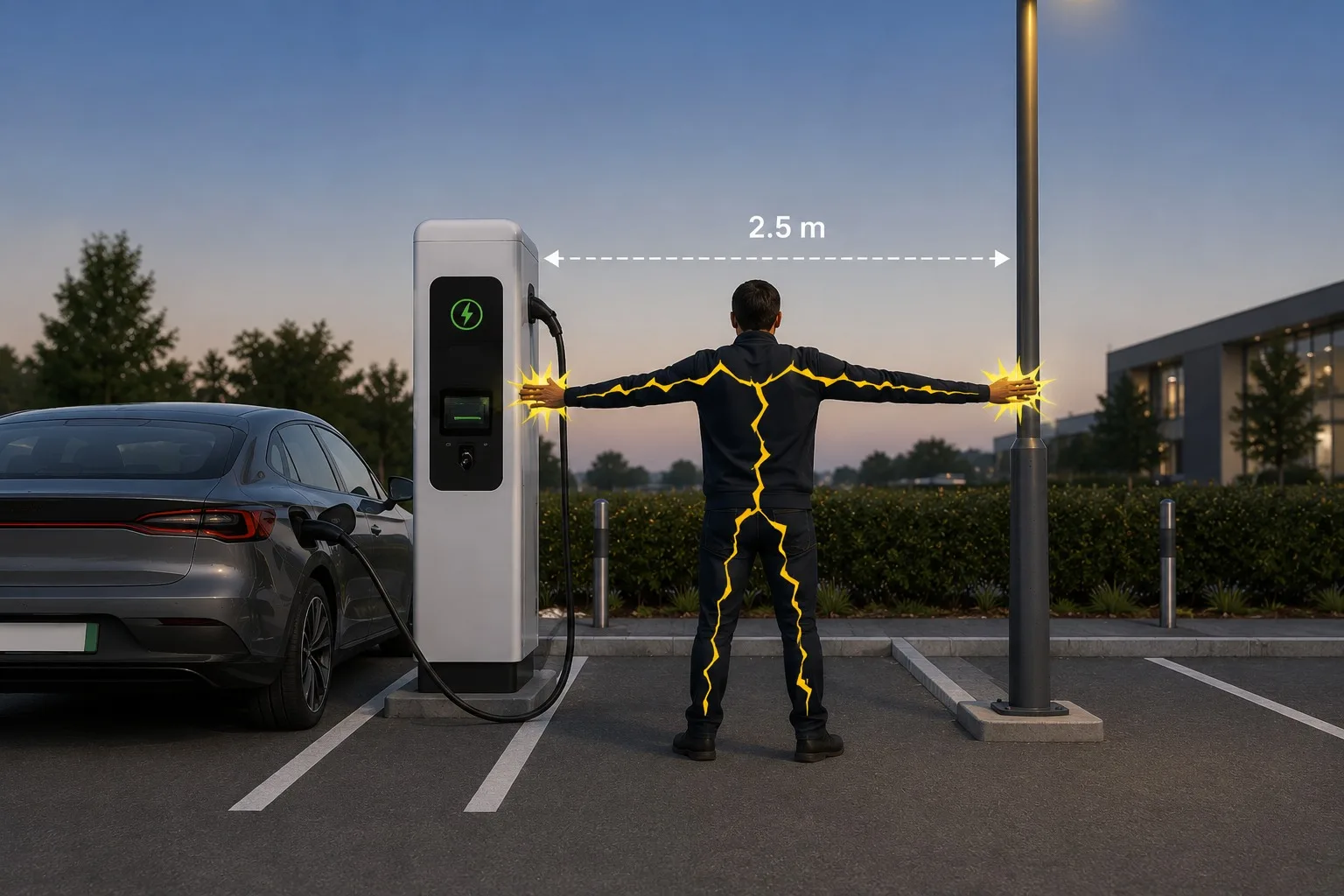
Which conductive parts can be at different potentials, and why?
Examples include contact between:
- two vehicles supplied from different systems;
- a vehicle and a lighting column;
- a vehicle and barriers, fencing or building metalwork;
- charging equipment and nearby conductive infrastructure.
A vehicle or charger may comply when considered in isolation but still present a risk where nearby conductive parts are influenced by a different source, substation or earth reference. A significant risk can arise from a Protective Earth and Neutral (PEN) fault on a TN-C-S supply, from a line-to-earth fault, or where nearby systems rise to different potentials during a network disturbance.
Protective devices are intended to disconnect the supply, but their operation is not instantaneous. During that period, a person bridging two parts at different potentials may be exposed to a hazardous touch voltage.
When should simultaneous-contact risk be assessed in the design programme?
Simultaneous-contact risk should be assessed during feasibility and layout development, rather than only at detailed design stage. Charger positions, parking bays, cable routes and equipment locations should be reviewed against nearby electrical systems and conductive structures before the layout becomes fixed.
The assessment should include both above-ground items, such as vehicles, lighting columns and metalwork, and below-ground systems, such as earth electrodes, cable armouring and buried conductive services. These interfaces can influence local earth potential and are therefore relevant when assessing both touch voltage and step voltage.
What does the approximate 2.5 m assessment zone cover?
Simultaneous-contact risk should be considered within the environment where the EV charging installation is being introduced, including the surrounding area within approximately 2.5 m of the vehicles, charging equipment and associated infrastructure.
Early assessment of nearby sources, earthing systems and conductive parts within this zone helps identify where potentially hazardous touch or step voltages may arise before the installation layout is finalised.