The local Distribution Network Operator remains involved where the new infrastructure connects to its network. Choosing an IDNO does not bypass the regional network or remove its capacity constraints.
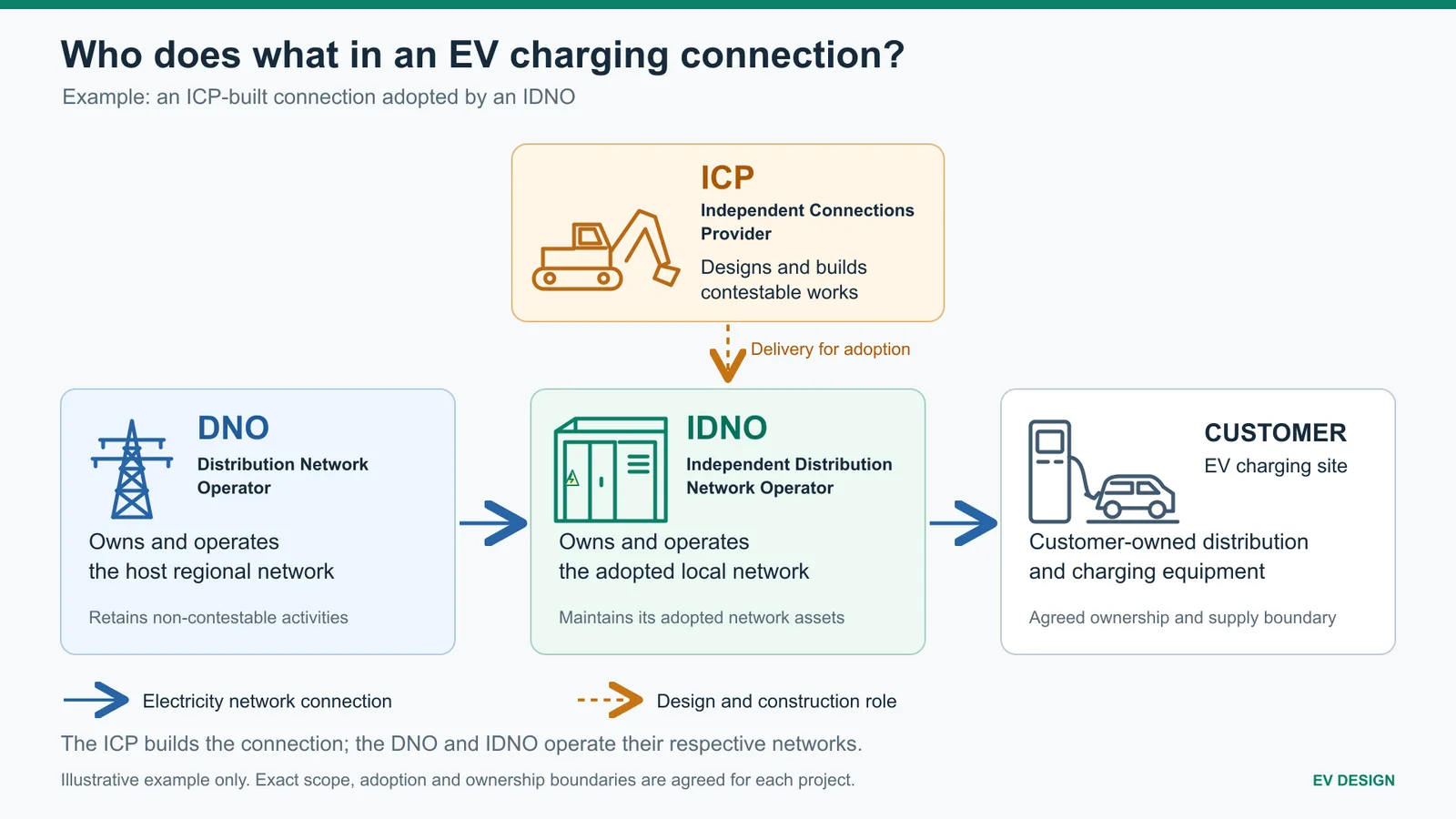
What does each organisation do?
DNO: Distribution Network Operator
The DNO owns and operates the regional electricity distribution network. The connection process establishes how the proposed demand can be accommodated, the connection point and the applicable technical and commercial conditions.
A client can ask the DNO to deliver the connection works, including infrastructure that will become part of its network.
IDNO: Independent Distribution Network Operator
An IDNO is licensed by Ofgem to own and operate electricity distribution networks. Its network connects to the host DNO's system and supplies the development through an agreed arrangement.
Following adoption, the IDNO operates and maintains the assets within its ownership boundary. Customer-owned equipment remains the responsibility of the customer or its appointed operator.
ICP: Independent Connections Provider
An ICP is an appropriately accredited company that delivers connection works. Its agreed scope may include design, civil works, cable installation, substations, testing and coordination of energisation.
The completed infrastructure can be adopted by either the DNO or an IDNO. Accreditation must cover the activities undertaken, with appropriately accredited specialists used where required. See UK Power Networks on appointing an ICP or IDNO.
What are the connection options?
Common arrangements include:
- The DNO delivers the connection and owns the adopted infrastructure.
- An ICP delivers the contestable works for adoption by the DNO.
- An ICP delivers the contestable works for adoption by an IDNO.
Some organisations offer combined services, but the delivery and ownership roles should still be identified.
Competitive construction and IDNO adoption are separate choices. An ICP does not have to use an IDNO.
What are contestable and non-contestable works?
Contestable works can be competitively procured from an appropriately accredited provider. These commonly include designing and constructing the new connection infrastructure, installing cables and equipment, and testing the completed works.
Non-contestable works are activities retained by the host DNO under the applicable connection arrangements. Depending on the scheme, these can include assessing the impact on the existing network, retained approval activities and work on the existing network that cannot be undertaken independently.
The exact split must be confirmed for the project. Some activities, including point-of-connection determination, design approval and final connection work, may be undertaken independently where the necessary accreditation, authorisation and agreements are in place. See SP Energy Networks on what work can be done and National Grid Electricity Distribution on types of agreements.
The final cable joint should therefore not automatically be assumed to be non-contestable.
Appointing an ICP or IDNO does not remove the host DNO's involvement. The independent provider must coordinate its work with the activities retained by the DNO.
How can an IDNO reduce the initial cost?
An IDNO may offer a payment for adopting qualifying network infrastructure. This is often described as an Asset Value or Asset Adoption Value. Two IDNOs describe their process publicly: UK Power Distribution and Eclipse Power.
That payment can reduce the client's net connection cost. Its availability and amount depend on the scheme, the assets being adopted, the proposed demand and the adopter's commercial terms.
Clients should establish whether the quotation already includes the payment, who receives it, how it benefits the client and which conditions must be satisfied before it is paid.
An adoption payment should be assessed against the complete connection cost. A substantial payment does not necessarily make one proposal better value if its construction costs, exclusions or associated obligations are higher.
Does an IDNO route give greater choice over delivery?
An ICP and IDNO arrangement provides another route for procuring and coordinating the connection. Clients can compare construction proposals, equipment arrangements and programmes against a DNO-delivered offer.
For EV charging developments, this can help align connection works with charger installation and the wider site programme.
The benefit depends on the organisations appointed and their agreed scope. An IDNO appointment alone does not guarantee an earlier energisation date.
Both DNOs and IDNOs operate and maintain their adopted networks. Long-term maintenance of adopted assets is therefore not a benefit unique to the IDNO route.
How should the full cost and programme be compared?
A contestable-works quotation should be assessed alongside the DNO's non-contestable offer and the customer-side installation costs.
The comparison should identify:
- Contestable design and construction costs.
- Applicable DNO non-contestable charges.
- Any asset-adoption payment and its conditions.
- Customer works, land rights, legal costs and exclusions.
- Responsibility for approvals, testing, metering and energisation.
Each cost should be counted once, with the scope clearly defined.
Completing a substation and its cables does not necessarily mean the connection can immediately be energised. Outstanding network activities, approvals, land rights or commissioning requirements may still govern the completion date.
An IDNO route also does not, by itself, establish that electricity will be cheaper to purchase. The electricity supply contract is a separate arrangement.
Where does the customer's electrical design fit?
The connection infrastructure and charging installation must meet at a clearly defined boundary.
Depending on the arrangement, a transformer, cables or feeder pillar may be network-owned or customer-owned. Ownership and operational responsibilities should be established through the drawings and agreements rather than assumed from the equipment's location or meter position.
The customer's electrical designer needs confirmed supply characteristics, fault levels, upstream protection and earthing information to develop the customer-side installation.
The team should agree who designs, supplies, installs, tests, owns and maintains each part before procurement.
How do you choose the right route?
An IDNO route is worth assessing where new adoptable infrastructure is required and an adoption payment could improve project viability.
Proposals should be compared against the same demand, connection capacity, scope and ownership boundaries. Planned expansion, load management, battery storage or generation should be identified early so that the connection arrangement reflects the intended development.
EV Design supports clients with electrical load assessments, connection applications and coordination of the customer-side electrical design. Working alongside our utility consultancy partners, we can also support discussions with DNOs, IDNOs and ICPs, helping clients compare proposals, clarify contestable and non-contestable responsibilities, and understand the implications for cost and programme. The government's guide to connecting electric vehicle chargepoints to the electricity network is the starting reference.
This article describes typical arrangements in Great Britain. The connection offer, adoption agreement and project appointments determine the responsibilities for an individual scheme. Reviewed 1 November 2026.